
Netto+ AI Prototype
Goal
To demonstrate how an AI can personalize the user experience for a grocery store. Figma was used to design a high-fidelity prototype of the Netto+ app with an incorporated AI. This AI made offers based on the user’s subjective preferences and data from the customer’s buying habits.
Background
Data can help grocery stores achieve a deeper understanding of their customers’ behavior. Using data can lead to a succesful personalization of the user experience, where the system anticipates users’ intentions and reduces their navigation and selection efforts. If grocery stores can give precise offers on what items the individual customer wants, they would design an ideal user experience, which would draw in more customers.
In our solution, we have focused on improving the Netto + app by incorporating AI to personalize the purchasing experience in the supermarket Netto by tracking the customer's purchase history and using this data to create more individual and relevant offers for the customer.
Findings
A study shows an algorithm is better at suggesting utilitarian goods that we need, instead of hedonic goods that we crave. Therefore, an incorporated AI would possibly not be able to understand a customer wanting an offer on hedonic foods and drinks on a Friday evening. AI is also very dependent on data, meaning that the user needs to be patient while the system adapts to their buying habits.
It was concluded the AI can have a very positive or negative impact on the grocery store user experience. It depends heavily on the system understanding the user’s precise shopping habits. This can be more difficult if the user suddenly makes drastic changes to what goods they purchase. It is also essential to note that you can never fully predict how an AI will process the user’s store purchases over a more extended period and how the user will react to the information given by the AI.
There is also an ethical challenge regarding an app that can potentially be designed to provoke an unhealthy lifestyle by giving consistent offers on unhealthy goods.
User needs
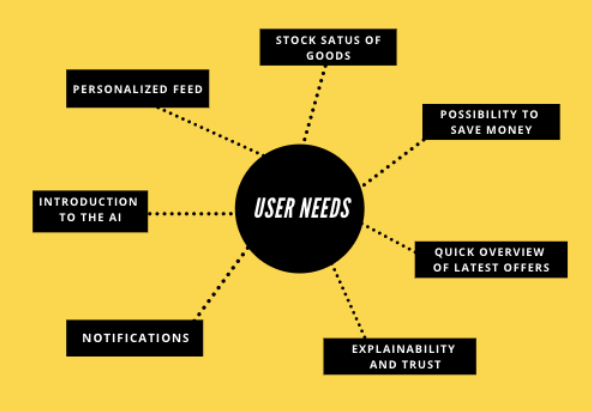
For humans and AI to work together successfully, sufficient trust in AI systems is crucial. To be trustworthy, AI's decisions must be understandable, explainable and reliable.
Regarding our case, it is essential to explain how the application responds to their actions in the supermarket. Consequently, we have focused on the user choosing predefined preferences to start with and kickstart the AI. In order to maintain the curiosity of the user, the personalized offers and recommendations must suit the needs of the user. When the recommendations do not match the users' preferences, it is impossible to build trust in the application.
Gains and Pains
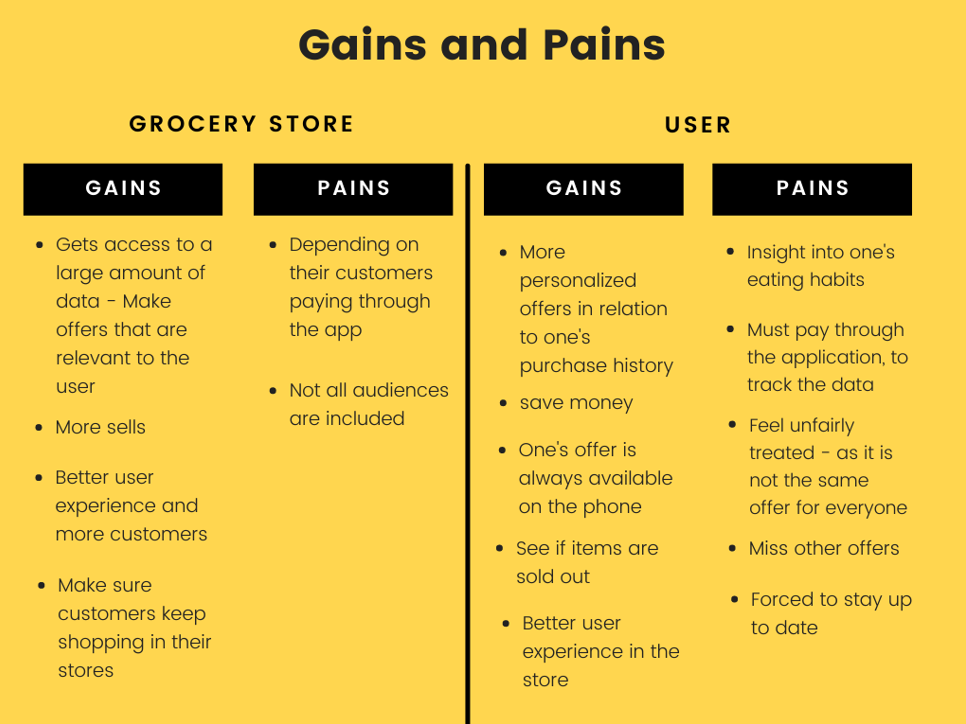
Next up, in the design process, we looked at related work to gather more knowledge and inspiration about grocery stores and how they engaged with their customers. Here we found similar situations from the danish grocery stores, Netto and Bilka. Among others, we used the two cases to map pain points and gain points for our design and what the application should consist of.
From concept to prototype
Use scenario
The use scenario of the Netto+ application is the following: the customer shops groceries in the local Netto and has therefore downloaded the new Netto + application to get and find more personal offers. Before the customer goes out shopping, the application is checked to see which relevant offers the customer should specifically keep an eye on. Here the customer can add these to his or her shopping list. The customer goes to his or her local Netto and opens the application to see which items to buy. Here the user checks the shopping list once again and finds the items using the application. The customer buys the groceries and scans the Netto+ application at check-out. The application saves the customer's purchase and will now gather more knowledge about the customer. The Netto+ app notifies the customer when there are offers for the customer's favourite item.
Wireframes
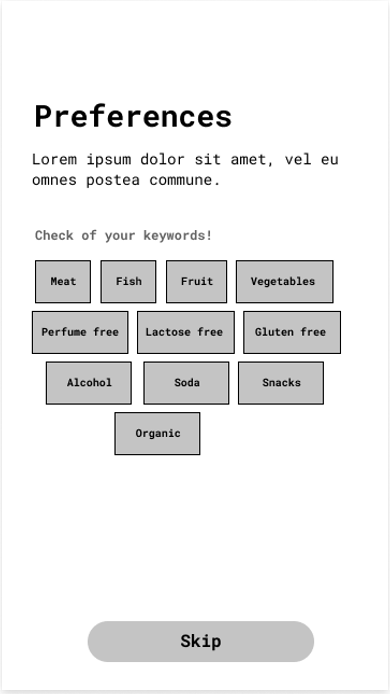
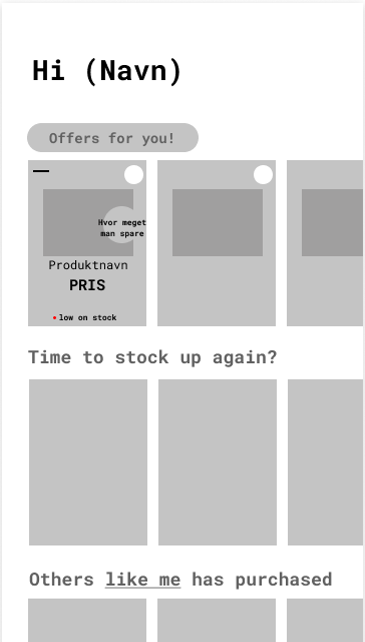
Low fidelity wireframes was created at the start to focus on the functional elements of the prototype instead of the visuals. The purpose was to decide where the different features should live in the app and only include the essential elements. Before developing the final prototype, the low fidelity wireframes were tested to see if the added features and categories made sense from a user-centric standpoint. Some adjustments were made to the wording of the different categories.
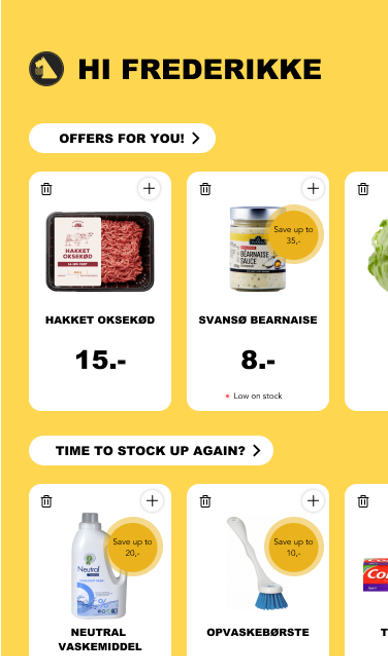
The high-fidelity prototype was later designed with added visuals and animation.
Prototype
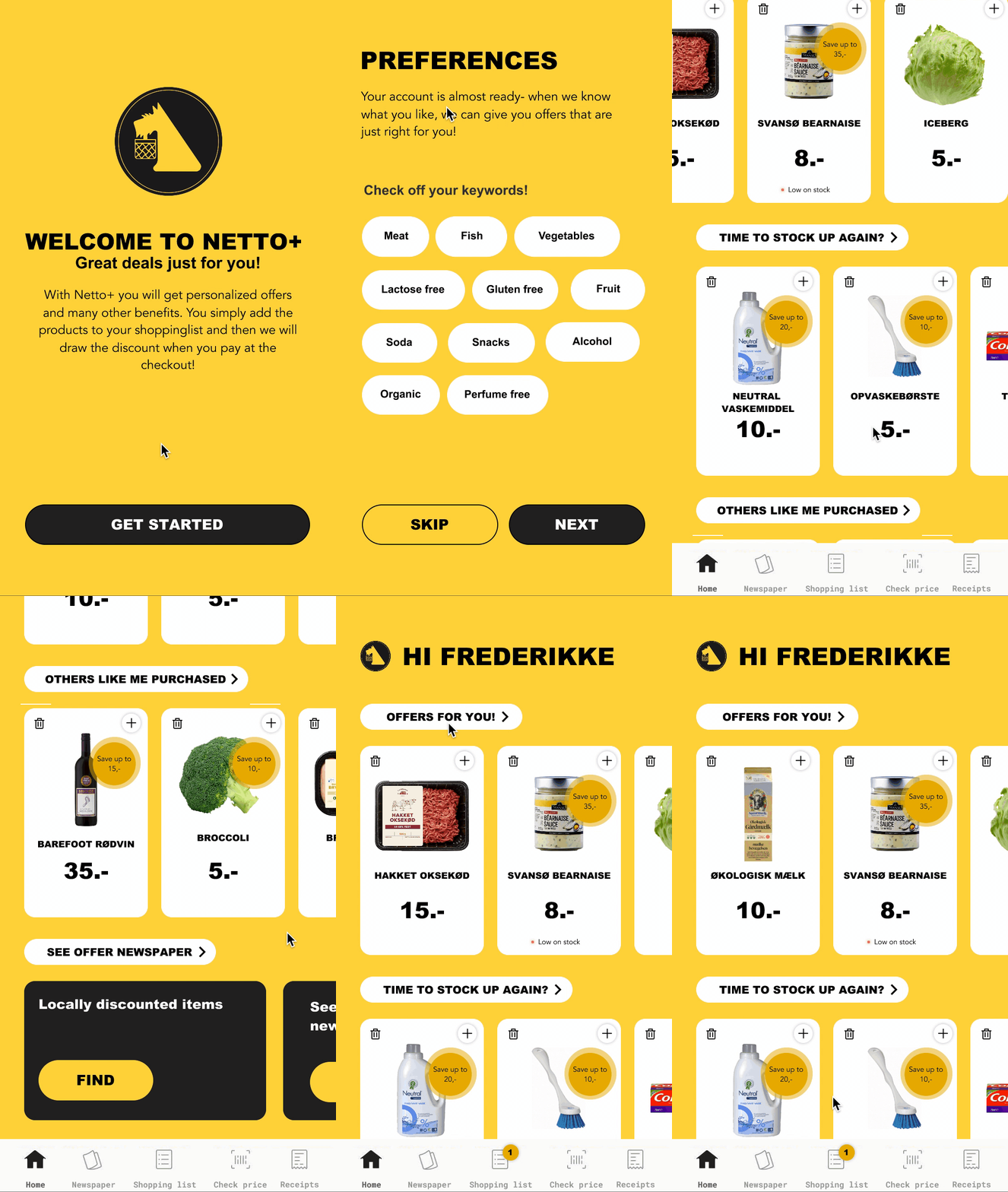
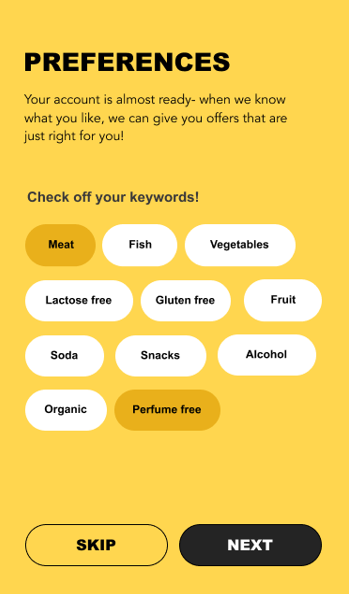
When downloading the app and using it for the first time, the customer has to complete the sign-up, where the customer is asked to choose his/her preferences. Here the customer is presented with several keywords to choose from, e.g.; Meat, fish, vegetables, organic and gluten-free. Based on the selected keywords, we will use AI to create valuable and relevant offers from the start to the customer.
After having completed the sign-up process, the customer will be presented for a product feed. In Netto's existing app, the product feed consists of two offer categories; Netto's offers and Personal Offers. Here, it was chosen to expand the categories to use the purchase data to better target offers and meet the customer's specific needs. The category; "Offers for you!" will be based on the type of products the customer buys in the supermarket daily. "Time to stock up again?" will be based on the products that the customer buys at intervals of a few weeks, including toilet paper, dishwashing liquid, etc. Lastly, "Others like me purchased!" will be based on the purchase history of others from the same segment. This category is meant to inspire and introduce the customer to other products that could be interesting. This feed will automatically adjust to the customer's habits and needs. We have also made it possible for the customer to delete an offer, allowing the customer to influence the AI and what offers that are being shown.
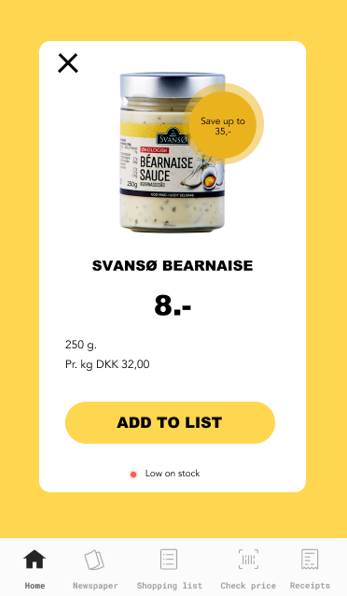
When the customer scrolls through the product feed and clicks on a specific product offer, the customer will see a product view, where the customer can read further details about the particular product. It is possible to add a product to the shopping list from the feed and the product view. Practically the customer's payment information is linked to the app, and when the customer adds a product offer to his/her shopping list, this will be taken into account at checkout when paying at the supermarket. As the transaction is completed, Netto can collect this data and thereby learn more about the consumer's buying habits.
This way, we use AI to create a more personalized experience that adapts to the customer.
User testing
Think-aloud test
When testing the prototype, we created a think-aloud test, where we have made four specific tasks for the respondent to solve. These tasks have focused on testing the respondent's overall experience and test if the user understands how the offers are personalized for the individual customer and lastly, if the app could be interesting for them to use. For the user test, we have recruited three respondents; Emma, Markus and Morten.
When solving the tasks, we asked the respondents to think aloud during the whole test to hear their thoughts and observe how they interact with the app.
We used Figma Mirror for the test to connect the prototype to the respondent's phone directly.
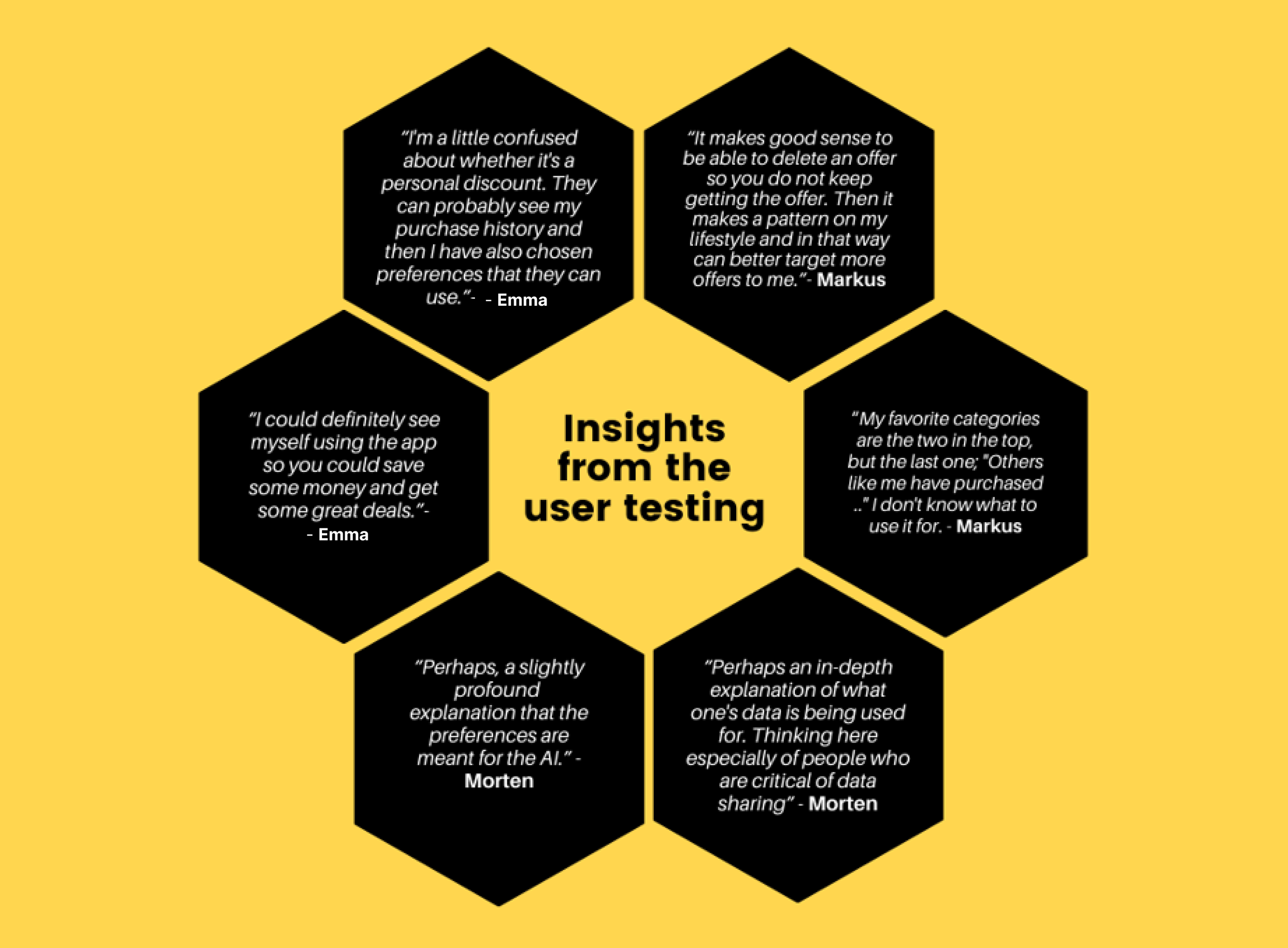
Both respondents had an overall good experience with the app and had an easy time solving the various tasks. They also understood how the offers are being generated based on the customer's purchase history patterns and how the delete function and preferences affect which offers are being presented. On the other hand, the respondent Emma was unsure if the offers were only targeted at him or if others got the exact offers. Markus was confused about the category; "Others like me have purchased" because he found it odd that he should receive recommendations based on what others had bought. Morten wanted it to be more clear how one's data is being used and how the preferences impact what offers one receives.
Reflecting on user feedback
Reflecting on what we have learned regarding user feedback, the “Others like me have purchased” category can arguably be considered worded inadequately. Given that the aim of the app’s extension is to personalize the user’s grocery shopping experience, it can be deemed contradictory that the app would suggest what “others like” the user have purchased, disrupting the personalized user experience in the process. Wording the category differentlycan make it less confusing for users such as Markus who prefers the personalized experience the app’s extension offers.
Should AI decide our food consumption?
How letting AI personalize offers on food is an ethical and data-driven challenge
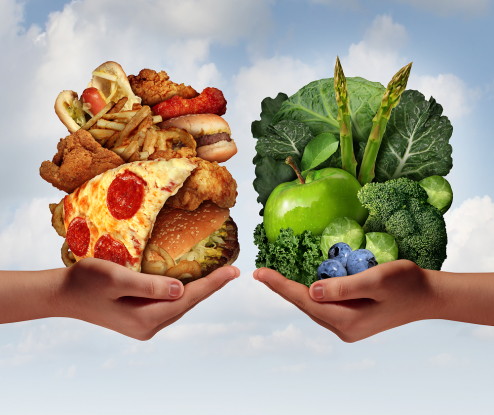
Consumers are often tasked to choose between utilitarian goods they need and hedonic goods they crave. Studies show that if someone is focused on utilitarian qualities, the word of a machine is more effective, while humans are more effective at focusing on hedonic qualities.
Reflecting on the studies, one might wonder if an AI can generate satisfying special offers for the user’s hedonic needs. Is the AI able to adapt to creating tempting offers on unhealthy foods and beverages on a Friday if it has spent the entire week recommending special offers on healthy greens and organic juices? The AI could very likely adapt to hedonic needs but not understand them the same way a human would. This can lead to anti-climatic user experiences for those hoping to buy pleasurable foods and drinks for a lower price.
Would we prefer if AI decided the consumption for us?
The question of how much AI should supply to humans’ hedonic needs also leads to a more considerable ethical discussion regarding how much AI should intervene in our private lives. If a specific user buys mostly hedonic foods and drinks, the app should by design generate special offers on even more hedonic goods. This would very likely cause the user to continue their unhealthy diet, unless the AI is programmed to intervene and generate offers on healthy hedonic food instead. Whether or not AI should “make the final decisions”, it has been argued that it is nearly impossible for humans to make accurate justification and selection without intensive computation within a short period. This is why we delegate mapping decisions to AI when choosing the best route to a specific destination on services like Google Maps.
Can AI end up controlling our consumption?
Researchers have argued that including ethical guidelines into algorithms is only possible to a limited extent and is always influenced by the people designing them. Researchers have argued further that it is necessary to retain “veto power” when the decisions can have far-reaching consequences for human beings. In the case of our prototype, giving too much power to AI deciding what consumption products are best for us could have the far-reaching consequence of humans losing control on their own consumption. Considering how purchasing hedonic goods to seek pleasure and even avoid pain is a motivational part of what makes us human, if AI slowly removes this hedonic motivation, it could be unhealthy for us on a more psychological level. Nudging users to have a healthier lifestyle can also backfire and cause the user to be unhealthier in other scenarios. Therefore, it can be argued that who decides what goods are best to purchase should be divided between AI and humans, allowing AI to automate tasks, while allowing humans to focus on work that will add value.
The Data Paradox
Another problem is that AI is fundamentally dependent on data. If the system does not have enough data on its users, the algorithm cannot draw any conclusions and make good recommendations, until it eventually has gathered the data to do so. This requires users to be patient with the AI learning and adapting to their buying patterns. For the Netto+ AI, this cold start can be fixed to some extent by making the app generate offers based on pre-existing data on offers the average user is most likely to capitalise on. This lets the AI make attractive offers to most users during the first few weeks, while it slowly learns the specific buying pattern of the user. But if the user capitalises too much on the early offers made by the AI, the AI might think the user has no special shopping habits and would possibly continue generating the same offers it has done since the user started using the app, creating a repetitive and frustrating experience for the consumer.